Clinical Evidence Review
Clinical Evidence Behind Nitric Boost Ultra
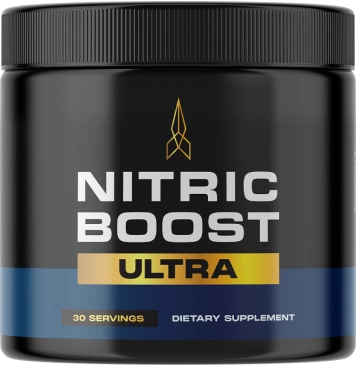
Review of clinical evidence relevant to Nitric Boost Ultra, including study hierarchy, individual ingredient evidence, dose comparability and finished-product limitations.
Save or follow this source
Add Male Performance Supplements to Google Preferred Sources or open this page in your preferred AI tool.
Desk ResearchEvidence LabelsSafety ContextUpdated Aug
Published Products
Explore all current MPS evidence-led product reviews.

Evidence hierarchy
What would count as strong product-specific evidence?
The most persuasive evidence for a commercial multi-ingredient supplement would be well-designed human trials testing the complete finished formulation, at the marketed dose, against an appropriate comparator and measuring clinically meaningful outcomes. From the sources reviewed for this project, such product-specific randomized evidence has not been established for Nitric Boost Ultra.
Instead, the scientific case rests mainly on evidence concerning individual ingredients. That can support biological plausibility and help identify promising components, but it is a lower level of support for claims about the complete product.
Ingredient evidence also varies. L-arginine has relevant randomized-trial literature in some erectile-function populations. L-citrulline evidence is smaller. Dietary nitrate has strong physiological relevance to nitric oxide and vascular measures, yet that does not prove sexual-performance outcomes from an unspecified beet-root dose. D-aspartic acid and horny goat weed illustrate more uncertain areas.
Evidence ladder
Do not collapse different levels of evidence into one claim.
Level 1
Mechanism
A compound participates in a pathway that could plausibly matter.
Level 2
Preclinical evidence
Laboratory or animal findings suggest activity but do not establish human clinical benefit.
Level 3
Human ingredient studies
Defined amounts of individual ingredients are tested in people.
Level 4
Finished-product trials
The complete commercial formulation is tested at its marketed dose.
Current MPS assessment: Nitric Boost Ultra has support mainly through levels 1–3 for selected components. Level-4 finished-product evidence has not been established from the reviewed sources.
Selected ingredient evidence
Strength differs across the formula.
L-Arginine
Relevant randomized and meta-analytic evidence exists in mild-to-moderate ED contexts. Interpretation depends on amount, population and study design.
L-Citrulline
Small human studies support plausibility but remain preliminary relative to established therapies.
Beet Root / Nitrate
Vascular and nitric-oxide physiology is well-supported, but product-specific nitrate exposure remains unknown.
D-Aspartic Acid
Human testosterone findings are inconsistent. Strong testosterone-boosting language is not justified by the current evidence.
Horny Goat Weed
Preclinical icariin/PDE5 findings are interesting, but robust human outcome data are limited.
Ginkgo, Dong Quai, Niacin
Research exists for various indications and doses, but presence in this formula does not establish the promoted finished-product outcome.
Dose comparability
Why trial doses matter to product interpretation.
A study can be methodologically strong and still be only weakly relevant to a commercial product if the product provides a different form or amount. The proper question is not “Has this ingredient ever been studied?” but “Does this product deliver a sufficiently comparable intervention?”
This applies especially to amino acids typically studied in gram-level quantities and to beet-derived nitrate, where nitrate concentration—not simply beet powder mass—drives the nitrate pathway.
Until the finished product's dose profile is established, MPS uses conservative language and does not extrapolate clinical outcomes directly to Nitric Boost Ultra.
Research-source trail
Primary literature is the evidence layer—not publication logos as endorsements.




These graphics are shown only to identify research/source contexts appearing in supplied materials. They do not imply endorsement of Nitric Boost Ultra by any institution or publication.
Nitric Boost Ultra evidence ladder: keep formula plausibility and product validation separate
The page already distinguishes several evidence levels. The key is to rank them rather than treating all scientific references as equivalent support for the finished product.
| Evidence level | What it supports | Relative strength for the finished product |
|---|---|---|
| Mechanistic rationale | Explains why an ingredient or pathway is biologically plausible. | Low for proving a finished-product outcome. |
| Ingredient human studies | Shows whether a specific ingredient has evidence in a studied context. | Moderate only when preparation, dose and population are comparable. |
| Formula matching | Shows whether the product resembles the researched ingredient amounts and forms. | Useful for plausibility but still indirect. |
| Finished-product controlled trial | Tests the exact formula against a directly relevant endpoint. | Strongest direct evidence when well designed. |
Interpretation: references strengthen a product review only to the extent that they match the actual formula, dose, population and outcome.
Selected references
Research trail
- Rhim HC, Kim MS, Park YJ, et al. Arginine supplements and erectile dysfunction: systematic review and meta-analysis. PubMed PMID 30770070.
- Cormio L, De Siati M, Lorusso F, et al. Oral L-citrulline supplementation in men with mild erectile dysfunction. PubMed PMID 21195829.
- Xu Z, Liu C, Liu S, Zhou Z. L-arginine and PDE5 inhibitors in erectile dysfunction: systematic review/meta-analysis. PubMed PMID 33587304.
- D'Aniello G, et al. D-aspartic acid and testosterone: systematic review. PubMed PMID 28280794.
- Current merchant/product materials supplied for this project, reviewed August 21, . Product formulation, prices, bonuses and guarantee statements are treated as merchant representations rather than independent efficacy evidence.
References are included for research context. Evidence on a constituent ingredient does not automatically validate the finished product.
Current merchant offer
Compare the current Nitric Boost Ultra package options.
The supplied merchant materials reviewed August 21, show one-, three- and six-jar packages. Commercial terms can change; verify the live checkout before purchasing.

1 Jar · 30 Days
$69 total · $69/jar
Shipping additional in the supplied offer.
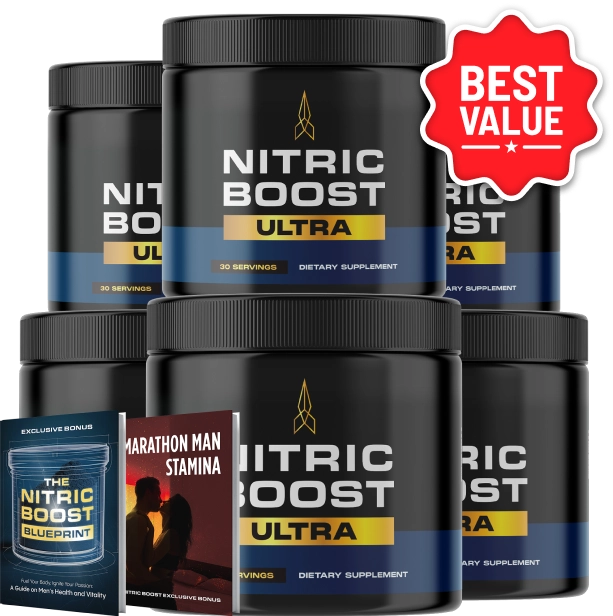
6 Jars · 180 Days
$294 total · $49/jar
Free U.S. shipping + two digital bonuses currently displayed.
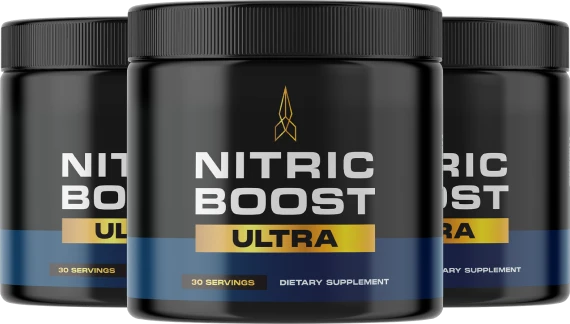
3 Jars · 90 Days
$177 total · $59/jar
Free U.S. shipping + two digital bonuses currently displayed.

Continue the research
Explore the Nitric Boost Ultra evidence cluster.
Safety & mechanism
Ingredient deep dives
L-Arginine →
L-Citrulline →
Beet Root →
D-Aspartic Acid →
Horny Goat Weed →