
Safety Centre
Supplement Safety: Interactions, Doses, Labels and Hidden Risks
A supplement can create risk through dose, medication interactions, contamination, hidden ingredients or stacking—even when the label describes it as natural.
Save or follow this source
Add Male Performance Supplements to Google Preferred Sources or open this page in your preferred AI tool.
Direct answer: The safest way to assess a supplement is to consider the actual dose, all other products and medications being used, the quality of the label, the user's medical context and whether the product belongs to a higher-risk category.
Learn how to read supplement labels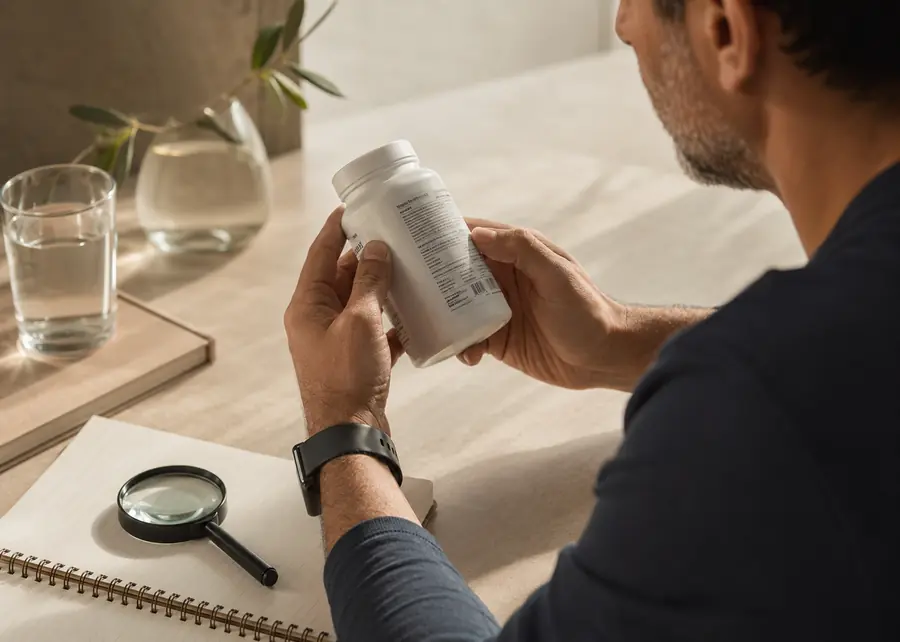
Published Products
Explore all current MPS evidence-led product reviews.

Interactions matter
Supplements can interact with prescription medicines and can also affect medical tests or procedures.
More is not safer
Some nutrients and active ingredients have upper limits or dose-related adverse effects.
Product quality matters
Contamination and undeclared ingredients are documented concerns in some supplement categories.
Count the whole regimen
The same ingredient can appear in multivitamins, standalone products and multi-ingredient formulas, increasing total exposure.
Natural does not mean risk-free
Botanical or naturally occurring ingredients can still have pharmacological effects, contraindications and interactions.
Safety depends on the specific product and person
There is no single safety verdict for dietary supplements. Risk depends on the ingredient, dose, duration, formulation, product quality, other supplements, medication use and the person's medical context. NCCIH specifically emphasizes that safety should be considered product by product rather than assuming a whole category is safe because it is sold over the counter.
Medication interactions are a core risk
Supplements can change the effect or absorption of medicines, and medicines can change the way supplements are handled. Some interactions reduce treatment effectiveness; others increase adverse effects. The practical implication is that a supplement list should be reviewed as part of the full medication history, particularly when several products are being used together.
Natural does not mean safe
NCCIH explicitly warns that “natural” is not synonymous with safe. Botanicals can have pharmacological effects, and naturally occurring vitamins or minerals can be harmful at excessive doses. Marketing language describing an ingredient as natural therefore provides almost no useful safety information by itself.
Dose and cumulative exposure can create avoidable risk
The same nutrient can appear in a multivitamin, standalone supplement and performance formula. Evaluating each bottle separately can therefore underestimate total daily exposure. Zinc, vitamin D and magnesium are common examples. Upper intake limits or dose-related adverse effects should be considered across the complete regimen.
Labels are necessary but not sufficient
The Supplement Facts panel helps identify serving size, listed ingredients and amounts, but a compliant label does not prove efficacy, purity or freedom from contamination. Proprietary blends can also make it difficult to know how much of each ingredient is present. See how proprietary blends affect dose transparency and evidence matching. Label reading is therefore the first safety screen, not the final guarantee.
Medical conditions can change the risk calculation
Kidney disease, liver disease, cardiovascular conditions, pregnancy, endocrine disorders and other medical contexts can alter whether an ingredient is appropriate. Even when a supplement is well studied in healthy adults, the evidence may not apply to people with significant medical conditions.
When to stop and seek help
Unexpected or severe symptoms after a supplement should not be dismissed as a normal “detox” or adaptation response. FDA provides mechanisms for reporting serious adverse events, and urgent symptoms should be handled through appropriate medical care. Publication-time versions of this page should verify current FDA contact and reporting instructions before presenting them.
Supplement safety risk map: product, person and context all matter
Safety cannot be judged from the ingredient name alone. Dose, product quality, medication use, health conditions and combined exposure can all change the practical risk profile.
| Risk layer | What to check | Why it matters |
|---|---|---|
| Product | Current label, dose, ingredient form, contamination and disclosure quality. | Two products with the same front-label ingredient can differ materially. |
| Person | Age, health conditions, allergies, pregnancy status where relevant, and individual sensitivity. | General population safety does not guarantee individual suitability. |
| Medication context | Prescription drugs, over-the-counter medicines and other supplements. | Interactions can arise from overlapping physiological effects or metabolism. |
| Total exposure | Combined intake across food, fortified products, multiple supplements and repeated doses. | Risk can come from cumulative exposure even when one product looks modest. |
Interpretation: supplement safety is a system-level question, not a single-ingredient checkbox.
Applying the evidence to a real decision
A useful decision process has three layers. First, define the intended outcome precisely enough that it can be matched to research. Second, inspect the actual product or ingredient information—form, amount, serving size, duration and relevant safety details. Third, ask whether the population studied resembles the intended user and whether the outcome measured is meaningful for the goal. This prevents a common error in supplement content: moving from a plausible mechanism or a positive result in one narrow setting to a universal consumer promise. When evidence is uncertain, the uncertainty itself is decision-relevant. It may justify choosing a better-studied alternative, seeking professional guidance, or deciding that the expected benefit is too small or uncertain to justify the cost and complexity of another supplement.
Risk is often created by combinations rather than one ingredient
Consumers commonly use several products that were not designed as one regimen. A multivitamin may overlap with a testosterone-support formula, while a pre-workout adds stimulants and a sleep product adds additional botanicals or minerals. Each label can look individually reasonable while the combined exposure creates an unnecessary dose, interaction or tolerability problem. A safety review should therefore include a simple inventory of every supplement, medication and fortified product being used rather than asking only whether one new bottle is safe in isolation.
Quality signals should be interpreted narrowly
Third-party testing, certification, transparent manufacturing information and batch documentation can all improve confidence in specific quality attributes. They should not be treated as proof of clinical efficacy. Conversely, the absence of a particular certification does not prove that a product is contaminated. The safety value of a quality claim depends on what was actually tested, by whom, and whether the certification can be verified. Strong marketing around 'purity' or 'pharmaceutical grade' should be checked against an identifiable standard rather than accepted as a general guarantee.
Why safety information should be revisited over time
Safety information is not static. New adverse-event reports, regulatory warnings, reformulations and interaction data can change the risk profile of a product or ingredient. Pages that discuss safety should therefore be updated when material new information appears, and time-sensitive claims should be checked before deployment. A historical absence of warning does not guarantee future safety, just as a newly issued alert may apply only to a specific product or batch rather than an entire ingredient category.
Frequently asked questions
Are natural supplements automatically safer?
No. Natural ingredients can still cause adverse effects and interactions.
Can supplements interact with prescription medicines?
Yes. Interactions are a major reason to review supplements with a healthcare professional.
Does a Supplement Facts panel prove a product is safe?
No. It provides required label information but does not by itself establish efficacy, purity or suitability for an individual.
Are bodybuilding and sexual-health supplements higher-risk categories?
Regulators and NCCIH have documented hidden or undeclared compounds in some products in these categories, so extra quality scrutiny is reasonable.
Sources
Primary and authoritative sources supporting the core claims on this page.
Related research
Apply these quality checks when comparing products
Testing, certification and transparent labeling can improve confidence in certain product characteristics, but they do not establish that a supplement is effective. MenPS organizes products using verifiable catalog and quality attributes.
Core Safety Guides
Go deeper on medication interactions, FDA regulatory status, certification claims and adverse effects.