Has Spartamax itself been clinically tested?
MPS did not identify a credible peer-reviewed randomized clinical trial of the finished Spartamax product in the source set reviewed for this project. That matters because clinical evidence for an individual ingredient does not automatically prove that a finished combination product will produce the same outcome. Formulation, dose, absorption, user population and study duration all influence results.
The correct evidence statement is therefore narrower: Spartamax contains ingredients that have varying degrees of human, mechanistic or indirect research behind them. The finished formula itself should not be described as clinically proven unless a product-specific trial is produced and can be evaluated.
What is the strongest ingredient evidence?
L-Arginine has one of the clearer human evidence bases relevant to erectile function. A systematic review and meta-analysis of randomized trials reported improvement in several erectile-function outcomes with oral arginine at studied doses. However, those trials used known amounts. Because the current Spartamax materials reviewed do not provide an independently verified L-Arginine quantity, MPS cannot conclude that the product matches the studied exposure.
This is a recurring theme across the formula: ingredient evidence is useful only when the formulation can be mapped back to the studies with reasonable confidence.
Tongkat Ali and testosterone
A systematic review and meta-analysis of Eurycoma longifolia found evidence of increased total testosterone across included trials, with particular relevance to men with low testosterone. That makes Tongkat Ali a meaningful research ingredient, but not a guarantee of a finished-product effect. Extract identity, standardization, dose and baseline hormone status all matter.
For Spartamax, the evidence therefore supports discussing Tongkat Ali as an ingredient studied in men; it does not support stating that Spartamax itself has been clinically shown to raise testosterone.
Ashwagandha
Randomized studies of standardized ashwagandha extracts have reported changes in testosterone, stress-related outcomes and aspects of male sexual health. These findings are encouraging, but they are extract- and dose-specific. Different preparations of the same botanical can vary materially in concentration and composition, which limits how confidently results can be transferred to a product that does not disclose the relevant specification.
Maca, Epimedium and indirect evidence
Maca has limited human research for sexual function and desire, while systematic reviews have noted the small and heterogeneous evidence base. Epimedium and icariin are frequently discussed in relation to PDE5-related mechanisms, but much of the evidence is preclinical or mechanistic rather than robust human outcome data. Beetroot and grape seed have vascular or antioxidant research that is relevant conceptually, but that research is indirect when evaluating a male-performance gummy.
Mechanism is not the same as clinical outcome
Marketing frequently converts a plausible mechanism into an implied result. For example, an ingredient may participate in nitric-oxide biology, yet that does not mean a finished supplement has been shown to create a clinically meaningful erection outcome. Likewise, an ingredient may influence a hormone-related pathway without proving that a particular product raises testosterone in the buyer.
For MPS, mechanistic evidence explains why an ingredient is included. Human outcome evidence determines whether there is support for a specific benefit. Product-specific evidence determines whether that support can be assigned to Spartamax itself. Those are three separate levels of proof.
Evidence rating
| Evidence area | MPS assessment | Main limitation |
|---|
| Finished Spartamax formula | Insufficient | No product-specific randomized trial identified |
| L-Arginine | Moderate | Current Spartamax amount not independently verified |
| Tongkat Ali | Moderate | Extract and dose matter |
| Ashwagandha | Moderate, extract-specific | Published trials use defined standardized extracts |
| Maca | Preliminary / limited | Small and heterogeneous evidence base |
| Epimedium / icariin | Insufficient for human outcome claims | Much evidence remains mechanistic or preclinical |
| Beetroot / grape seed | Indirect | Vascular research does not establish Spartamax efficacy |
What would strengthen the evidence?
Three things would materially improve confidence: a current Supplement Facts panel showing exact ingredient amounts and forms; independently verifiable quality/testing documentation; and a peer-reviewed controlled study of the finished formula. The first would allow dose comparison with existing studies. The second would improve confidence in product identity and quality. The third would address the most important unresolved question—whether the combination itself delivers measurable outcomes.
Bottom line
The Spartamax formula includes ingredients with genuine scientific interest, but the evidence should not be overstated. Some components have moderate human evidence for specific endpoints; others have only preliminary, mechanistic or indirect support. MPS found no basis to describe the finished product as clinically proven. The strongest evidence-led position is to separate what has been studied from what the seller markets and what remains unknown.
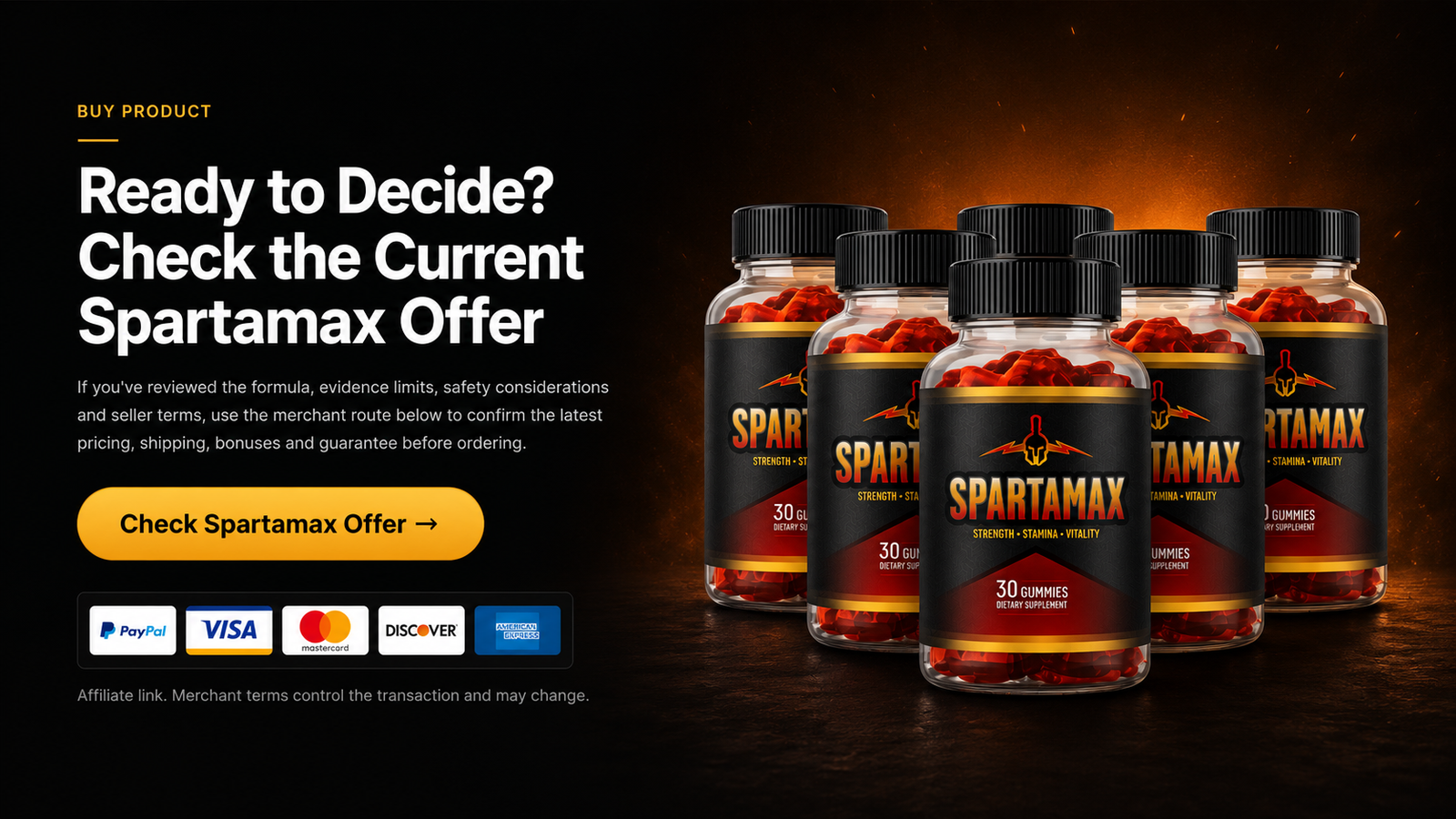
BUY PRODUCTCheck the Current Spartamax Offer
Merchant pricing, shipping, bonuses and guarantee terms may change. Confirm current terms before ordering.
Check Spartamax Offer →